
Chimney Sweep: Repair or Replace? How South Hill Homeowners Decide
There’s no single answer to repair-or-replace, and any company that gives you one before inspecting your system is guessing. A chimney company that always recommends repair and one that always recommends replacement are both getting it wrong. The right call depends on where in your chimney system the problem lives, what’s causing it, and whether the surrounding parts can support a fix for the lifespan you expect from it. Here’s the framework we use to think through it, so you can evaluate a recommendation instead of just accepting it.
If you’d rather have fresh eyes on your system than reason it out alone, call (877) 792-6671. We answer 24/7, with fast dispatch from 7am to 7pm, Sunday through Friday.
Is age a good reason to replace a chimney system?
Rarely on its own. Age tells you how long the system has been exposed to weather, creosote, and heating and cooling cycles, but it doesn’t tell you which parts have actually failed. A well-built brick chimney that’s been capped and maintained can outlast a newer one that’s been taking water for years. Conversely, a chimney that looks old on the outside can have a perfectly serviceable liner and firebox.
The better question is component condition. Each part of your chimney system has its own failure modes, its own inspection method, and its own repair-versus-replace threshold. South Hill’s wet winters and freeze-thaw swings put real stress on masonry, so we look at what the weather has actually done, not at a calendar.
What we advise homeowners to ask:
- Which specific component has failed, and how was that confirmed?
- Is the failure structural, water-related, or wear from use?
- If we repair it, how long should the repair last given the condition of everything around it?
- What happens to the repair if an adjacent component fails next year?
A technician who can answer those four questions clearly is giving you a real assessment. One who can’t is giving you a sales pitch.
Repair or replace: liner, crown, firebox, cap, and flashing
Each part of the system has a different threshold. Treating them as one decision is where homeowners get talked into work they don’t need, or talked out of work they do.
The liner
A clay tile liner with a hairline crack in one flue is often repairable. A liner with widespread spalling, gaps at the joints, or missing tiles is a different story. Stainless relining using a system like DuraFlex is the standard route when the existing liner can’t be saved. The decision here comes down to how much sound tile you have left and whether the flue serves a wood fireplace, an insert, or a stove that needs a specific diameter.
The crown
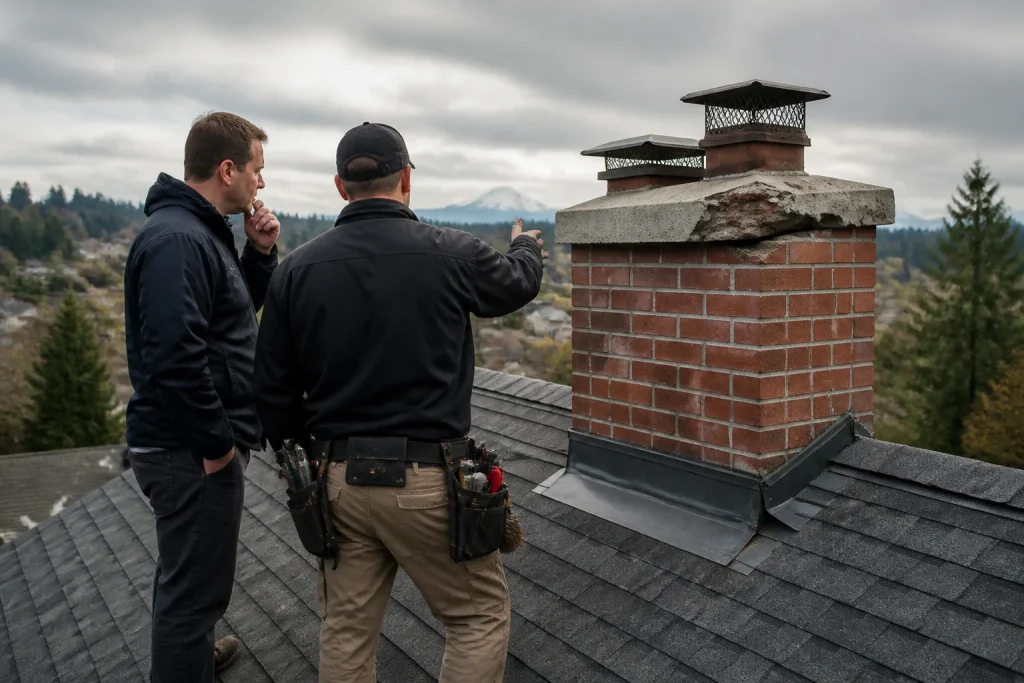
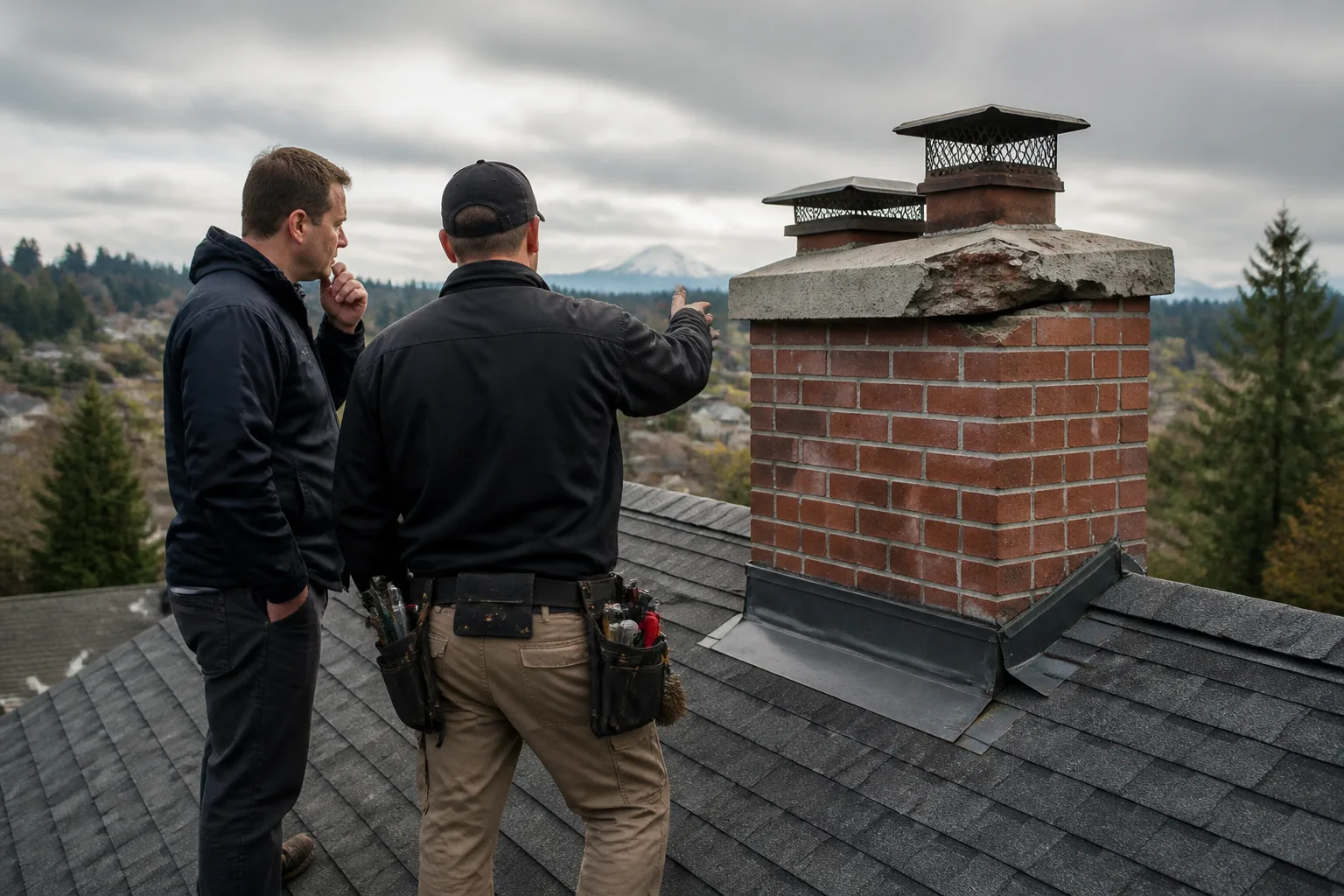
The crown is the concrete cap at the top of the masonry that sheds water away from the chimney. Hairline cracks get sealed. A crown that’s cracked through, separated from the flue, or sloping the wrong way needs to be rebuilt. This is one of the most common sources of water intrusion we see, and it’s worth fixing properly rather than patching.
The firebox
Firebox brick and mortar take direct heat. Isolated mortar joint failure can be repointed. Cracked firebox brick, especially in the back wall, usually means a rebuild. HeatShield resurfacing is worth discussing here, because it can restore a firebox surface without a full tear-out in qualifying cases.
The cap
Caps are inexpensive and easy to replace. A missing or damaged cap lets water, animals, and debris straight into the flue. This is the simplest replacement decision in the whole system, but it’s also where we see the cascading-failure problem described below.
Flashing
Flashing is the metal seal where the chimney meets the roof. Failed flashing causes water to track down the outside of the chimney and into the attic. It’s almost always a repair, not a replacement, but it needs to be done with proper materials and correct step and counter-flashing, not sealant smeared over a gap.
How does HeatShield resurfacing change the calculus?
HeatShield is a resurfacing product applied to the interior of a smoke chamber or liner wall to restore a smooth, sealed surface. For South Hill homeowners facing a liner recommendation, it can be the difference between a repair and a full tear-out. When the existing liner structure is sound but the surface is deteriorated, resurfacing can restore it without pulling the whole thing. When the liner has lost structural integrity, resurfacing is the wrong tool and a full reline is the honest answer.
We’re able to offer resurfacing because we work with HeatShield as one of our professional-grade product lines, alongside DuraFlex for relining and Copperfield and Famco for caps and related components. That matters less than knowing when each one applies. Resurfacing a compromised liner just delays the inevitable and costs you twice.
Ask any technician recommending resurfacing one question: what’s the structural condition of the liner underneath the surface they’re coating? If they can’t answer with documentation, that’s your signal.
Why replacing a cap on a failing crown is a short-term fix
Chimneys fail in cascades. Water gets past the crown, runs down the flue, and finds the weakest joint. Replacing the cap on a system with a compromised crown looks like a fix, but the crown is still letting water in, and the new cap is now sitting on top of a chimney that’s still deteriorating from the inside. You’ve paid for a repair that addresses a symptom while the cause keeps working.
The cascading failure principle works the other way too. Fixing the crown, flashing, and cap together protects everything below them. Once water is kept out, the liner and firebox have a chance to dry out and stay sound. In South Hill, where masonry absorbs a lot of rain between heating seasons, water management is where most long-term chimney health actually lives.
This is why we treat cap, crown, and liner as a connected conversation rather than three separate line items. The parts protect each other, and the order of repair matters.
Need a full look at your system? Our chimney sweep includes an inspection that flags these issues before they compound.
What should a written inspection report actually contain?
Without documentation, a repair-or-replace recommendation is just an opinion. A credible report gives you the evidence to make the decision yourself, or to share with an insurer, a buyer, or a second opinion.
A useful report should include:
- Photos of each component inspected – crown, cap, flashing, flue interior, firebox, damper. Photos you can see, not just described.
- Specific findings per component – not “liner shows wear” but “hairline crack in flue tile, joints intact, no spalling.”
- The recommended action for each finding, and whether it’s urgent, maintenance, or monitor.
- What was NOT inspected and why – if a camera couldn’t reach a section, say so.
- Product and material callouts – a DuraFlex reline recommendation should name the system, not just “new liner.”
We deliver documented inspections because a report you can hold onto is what insurance companies and real-estate transactions expect. If you’re buying or selling a home in South Hill, an inspection that stands on its own protects you far better than a verbal assessment.
When to call a pro, and how to get a second opinion
Any repair involving the liner, firebox, or crown is not a DIY job. Creosote buildup, hidden cracks, and the structural load on masonry mean a mistake can compromise the whole system. Call a professional when you see water stains, smell smoke in the room, notice crumbling mortar, or hear a change in how the fireplace draws.
Second opinions on a major recommendation are reasonable, and a confident technician won’t mind. Bring your written inspection report, photos of the issue, and whatever documentation the first company gave you. Ask the second assessor to walk through each finding and explain why they agree or disagree. A credible counter-assessment will reference the same components with the same specificity. One that just says “you don’t need all that” without explaining why is no better than the first opinion.
Related services in South Hill: if the issue is indoors, our fireplace repair covers firebox and damper work; structural and liner issues fall under chimney repair; and Chimney Sweep South Hill is where we start every relationship with a sweep and inspection.
The Bottom Line
Repair or replace isn’t a single verdict, it’s a component-by-component assessment backed by documentation you can see. Fix the root cause, not the symptom. Keep water out and the rest of the system lasts longer. Ask any technician which part failed, how they confirmed it, and what happens to the repair if the neighboring parts fail.
If you’re in South Hill and want a clear, documented answer on your own system, we offer free estimates. Call (877) 792-6671. Our technicians have up to 15 years of experience, and we handle the sweep and anything we find.
Frequently Asked Questions
How much does a chimney sweep cost in South Hill?
A standard sweep and inspection usually runs in the typical range for the area, and the written estimate sets the final price. Call (877) 792-6671 for a free estimate on your specific system.
Do I really need a new liner, or can it be repaired?
Sometimes repair or resurfacing is possible; other times a full reline is necessary. It depends on the structural condition of the existing liner, which is why we document findings with photos. Ask for proof before accepting a full replacement.
How often should a chimney be swept?
Once a year is the standard for wood-burning fireplaces, inserts, and stoves, and more often with heavy use. An annual sweep catches small issues before they become expensive repairs.
What actually happens if I skip it?
Creosote builds up and can catch fire inside the flue, and small cracks go unnoticed until water gets in and masonry starts to fail. Annual maintenance is far cheaper than the repair that skipping it eventually requires. Call (877) 792-6671 to schedule.
Written by the team at Chimney Sweep South Hill.
Need Chimney Cleaning Help?
Call Chimney Sweep South Hill - the local pro we connect you with is licensed and insured, here with fast help in South Hill.
(877) 792-6671